

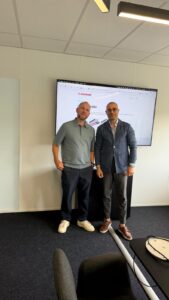
Copenhagen, Denmark — As part of Flussirari’s continued exploration of European lighting innovation, Mike Khabour, CEO of Flussirari, recently visited a specialized technology and production environment in Copenhagen to explore how advanced LED lighting technology is moving beyond conventional illumination.
The visit focused on emerging applications including vertical farming lighting, healthcare lighting, UV-C technology, parking infrastructure and long-life LED systems.
One direction became particularly clear:
Light is becoming more than illumination. It is becoming functional infrastructure.
The Copenhagen visit also highlighted how rapidly LED technology is expanding into specialized applications where lighting is becoming increasingly connected to the function of the environment itself.
For Flussirari, this represents an important evolution in lighting: understanding not only how light illuminates a space, but how technology can respond to the specific requirements of different applications.
Vertical Farming: When Light Becomes Part of Production
One of the most significant areas explored in Copenhagen was LED lighting for vertical farming and controlled-environment agriculture.
Unlike conventional architectural lighting, vertical farming uses light as part of the production environment. Spectrum, intensity, operating cycles, energy efficiency and intelligent controls can all influence how an indoor growing system performs. LED technology is particularly suited to agricultural applications because it can provide different spectra, distributions and intensity levels.
Here, light is not simply revealing the environment.
Light becomes part of the production system.
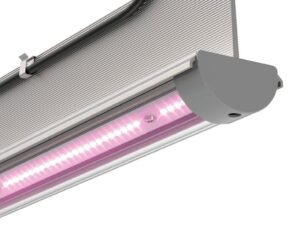
This direction is reflected in GARDENIA, a Flussirari solution developed for applications involving farming and controlled cultivation. The product illustrates how LED technology can be designed not simply to illuminate a space, but to support the specific functional requirements of a growing environment.
Healthcare Lighting & UV-C Technology
The Copenhagen visit also explored developments in healthcare lighting and UV-C technology.
Hospitals and clinics require lighting that considers visual comfort, reliability, energy efficiency and operational performance. Advanced tunable LED systems are also being studied for their potential role in improving lighting quality and control within healthcare environments.
UV-C takes lighting technology into another specialized field. It can be used in appropriately engineered disinfection applications, but its implementation requires careful safety controls, testing and application-specific design.
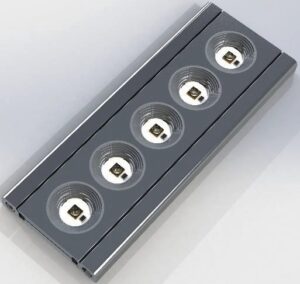
This is the context in which CALIPSO UV represents a specialized Flussirari approach to UV-C technology, connecting lighting engineering with applications where the light source performs a specific functional role.
Technology creates value when it solves a meaningful problem.
Parking & Long-Life LED Systems
For parking lighting and infrastructure, the priorities change again: long operating hours, visibility, energy efficiency, reliability and maintenance become fundamental.
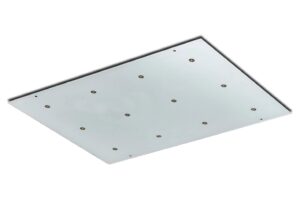
These requirements are reflected in MAGNOLIA, a Flussirari solution for parking and infrastructure applications, where dependable performance and efficient illumination are essential to the operation of the environment.
This connects directly to another important direction in LED engineering—longer operational life.
The performance of an LED system depends on more than the LED source itself. Electronics, drivers, thermal management and other components can influence the useful life and reliability of the complete lighting system.
Longer life can mean fewer replacements, reduced maintenance and lower material consumption.
Longevity is also sustainability.
The Future of LED Lighting
Vertical farming. Healthcare. UV-C. Parking infrastructure. Long-life LED systems.
Different applications reveal the same evolution.
The question is no longer only:
“How much light does this product produce?”
The more important question is becoming:
“What can this lighting system enable?”
The Copenhagen technology visit reflects Flussirari’s continued exploration of European lighting innovation and the technologies shaping the next generation of LED systems.
Because the future of lighting will not be defined only by how well we illuminate a space.
It will be defined by what light enables that space to do.
Flussirari Team